When agents are handling whole companies, personal projects, and household logistics — what exactly do I do? That's not rhetorical. I spent a few weeks not answering it directly, managing a stack of things in my head, trying to remember which agent was doing what work and when I should check in.
What I needed wasn't more agents — I went from 29 back down to 13. It was one screen for all the threads I needed pulled. There's a version of the Command Center story that's about efficiency — one screen to rule them all. That version is true but it's not the point.
The point is trust.
One Screen to See Everything
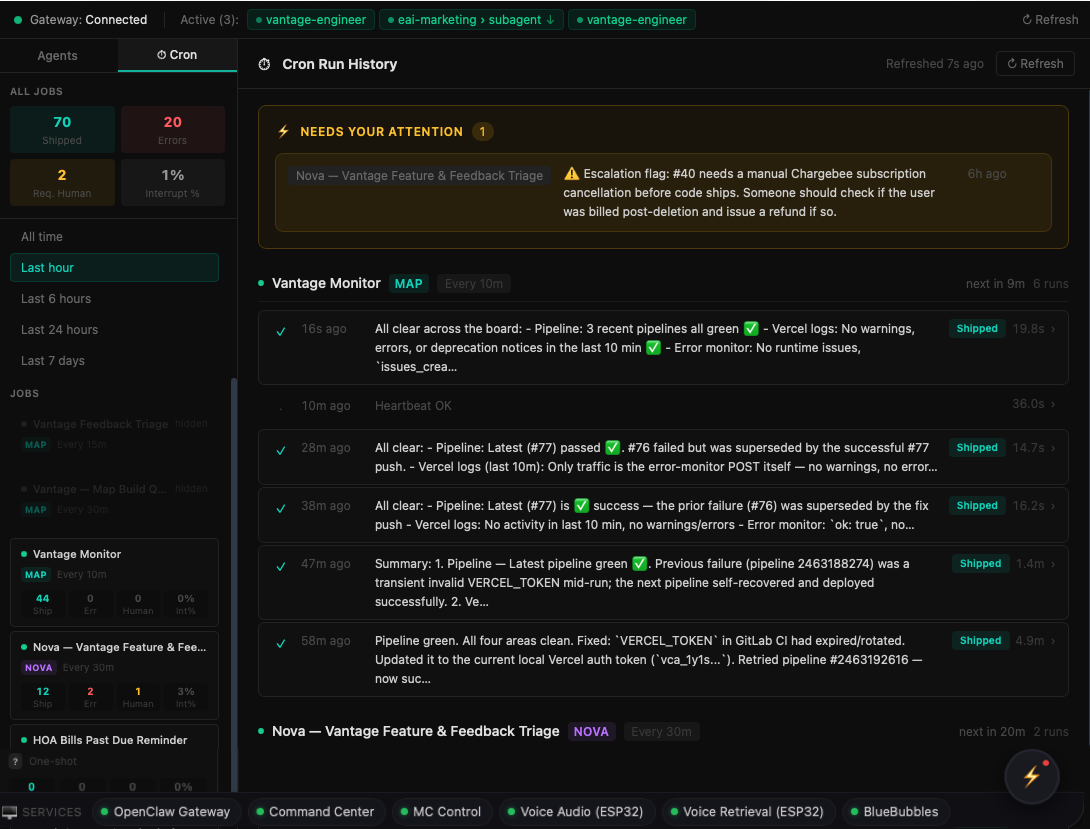
When I built the Command Center, I thought I was building an operations dashboard, so it looks like there is a lot going on. What I was actually building was a way to measure how much I trust the system — and how much the system has earned that trust, so the only thing on this screen that requires my attention is the box in yellow, everything else can be toggled to hidden and usually is.
Five things surface here: the Agents tab for parallel conversations across 13 agents, each managing their own sub-agents; Active Sessions showing what's running and what it costs; Server ⚡ Management for the GPU instance I run for local models; a Services Status bar that tells me when a service goes down silently, so something somewhere won't work right; and the Cron tab — the most important — where I can see what the software engineer ran at 2am, what the backlog review decided this morning, what the customer agent handled overnight. The metric I'm watching is human interrupt rate. That number should go down, and it is. I do not address errors — agents do that autonomously.
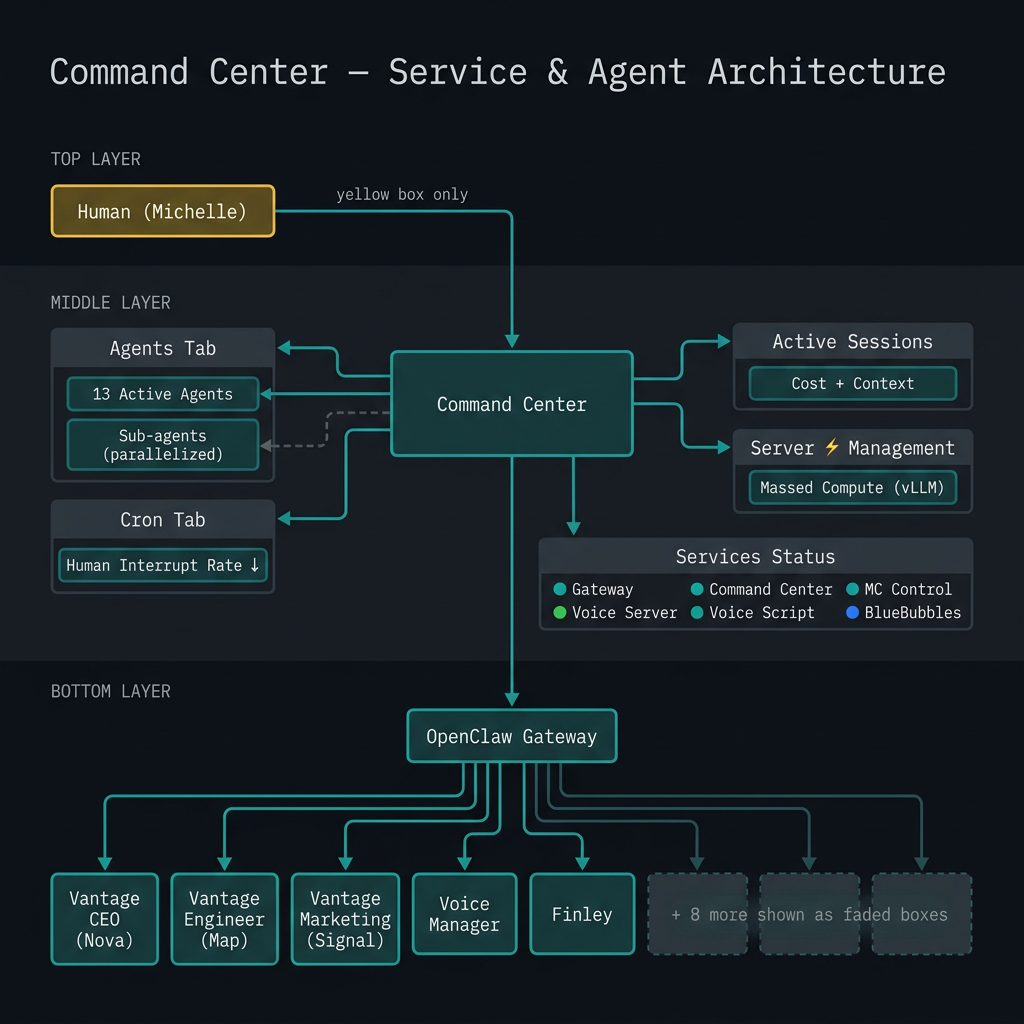
Why It Exists
With a human team, trust is partly an act of faith. You can't see every decision that was made while you weren't watching. With agents, I can — the logs, cost, and context are all there. But the yellow box is the one thing that says: this required you. Everything else is evidence to give you the confidence to let go.
Polly built this while I was describing the problem. I didn't spec it, write a brief, or review a plan. I described the problem — too many threads, wanting to start even more, can't remember everything going on, some things really will require me and I don't know what those things are yet — and it appeared.
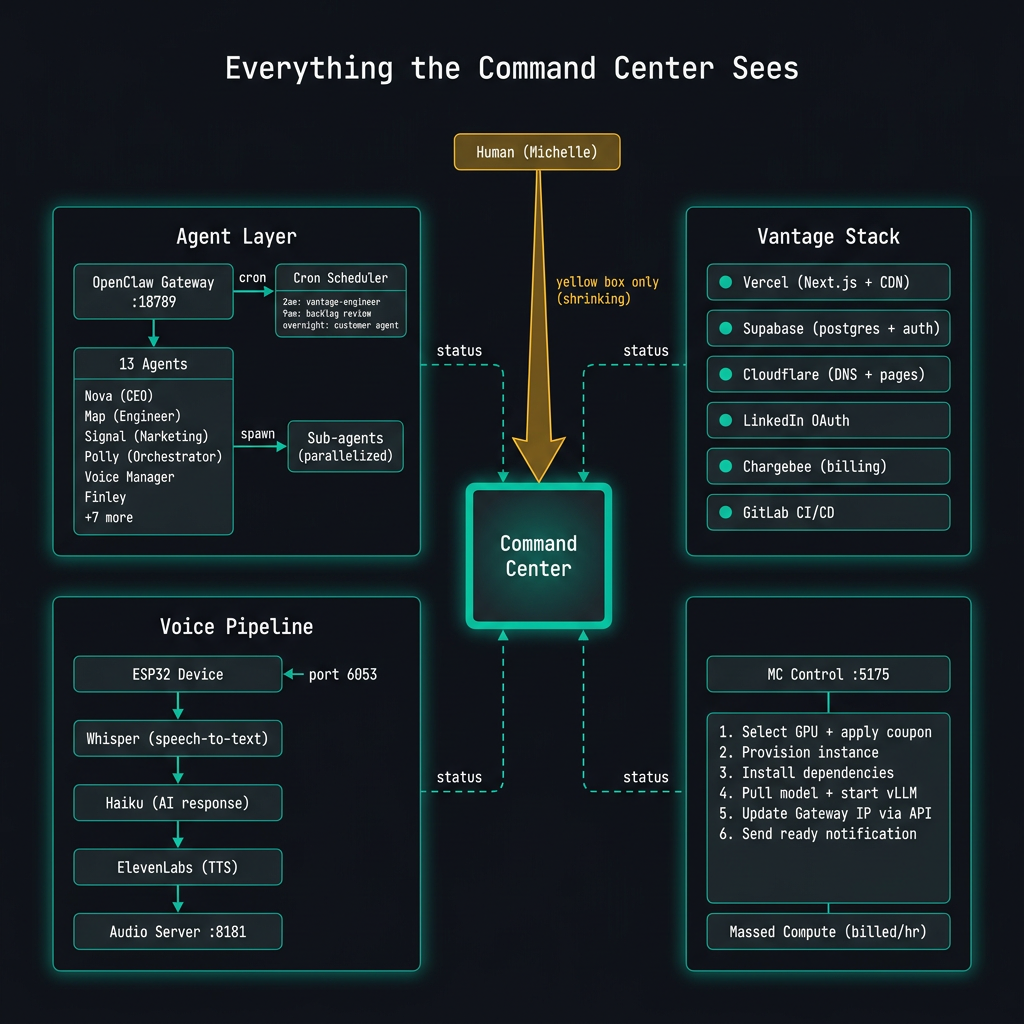
The diagram below is the better answer to why, and why I thought I was building an Operations dashboard at first. My voice pipeline alone is five steps. Vantage, a project Polly is overseeing, is a separate architecture: Vercel, Supabase, Cloudflare, LinkedIn OAuth, Chargebee, GitLab CI. The GPU server is a six-step lifecycle on every restart. Multiply the clusters in that diagram by at least 7, because they are just a few examples of many other operations that are ongoing at a given time. The question stops being "why build a Command Center" and starts being "how were you managing this without one?"
What Gets Automated Away
Every time something requires me more than once, I build it out of the way.

The clearest example: Nova escalated a billing issue to me directly — he's the CEO for a project Polly started, and he made the right call to ensure the customer was refunded, but he didn't have billing access. There's one other person who does: Polly. That was the last time Nova came to me for that. Now he goes to Polly.
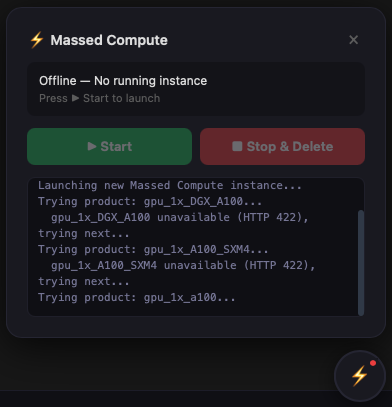
Another example: the Server Management tab. A stopped GPU instance still bills you — the only way to stop the clock is a full terminate, which wipes the machine and requires a fresh build every restart. One click on the lightning bolt handles all of it now: billing, configuration, dependencies, IP updates, and every agent that depends on the server.
The same principle applies to anything with a lifecycle or a failure mode.
The Difference Between Visibility and Involvement
The yellow box is a shrinking category. That distinction — I could look, but I don't have to — is what trust feels like with a team that works. Access isn't involvement. Choosing not to look is the signal.
The dashboard enforces the line between things I have to do and things I'm watching, which is something I'm trying to concretely determine, since the two have blurred significantly. Nova escalating a billing issue to me lasted exactly one time. Now he goes to Polly. That's the work: every time something lands in the yellow box, I ask whether it needed to. What's outside it is evidence the system is working — or that an agent is already handling it. I've already abstracted myself from all of the services in the diagrams above, and it's been weeks since I've been down to the lowest level: the code itself.
The answer to what my job is: whatever the yellow box says, until it says nothing.